Pierre Poilievre used a recent Bloomberg interview to present a firm argument about Canada’s place in its trade dispute with the United States. His main point was straightforward: Canada should not approach these talks as if it has no real influence to bring.
Speaking with Bloomberg This Weekend anchor David Gura, Poilievre returned again and again to one word, leverage. He argued that Canada holds more negotiating strength than many observers assume, especially because of how closely its economy is tied to American production and industry.
Rather than describing Canada as a small player reacting to pressure, Poilievre portrayed the country as an essential supplier. In his view, the United States may be larger, but it still relies heavily on Canadian resources, materials, and steady economic cooperation across many sectors.
One of the most important claims he made was that much of what Canada sells to the United States is not bought for simple final use. Instead, it enters American factories, construction projects, transport systems, and broader production networks that support jobs.
That idea formed the center of his message. If Canadian goods are helping American businesses operate efficiently, then Canada is not standing outside the system looking in. It is part of the system itself, and that creates room for meaningful bargaining and practical demands.
Poilievre pointed to products such as oil, lumber, aluminum, and other key materials as examples of this connection. These are not marginal exports with limited value. They are inputs that affect costs, supply stability, and long-term industrial planning for American companies and workers.

By emphasizing supply chains, he tried to move the discussion away from simple trade imbalances or political slogans. His argument suggested that the relationship between the two countries is built less on competition alone and more on mutual dependence that cannot easily be replaced.
That is where his use of the word leverage became especially significant. Poilievre was not saying Canada should threaten for the sake of appearing strong. He was saying that Canada should recognize where its real economic importance lies and negotiate with more confidence.
A major part of that argument focused on energy and critical minerals. Poilievre suggested that Canada possesses resources the United States needs for industrial growth, manufacturing resilience, and defense-related supply chains. In that sense, he framed Canada’s resource base as both an asset and a strategic tool.
He proposed that Canada could offer greater access to affordable energy and important minerals if the United States responds with tariff-free trade in major sectors. He specifically connected that approach to industries such as steel, aluminum, autos, and lumber, all central to cross-border commerce.
This was not presented as a call for separation or retaliation without purpose. Instead, Poilievre described it as an effort to reset the tone of the relationship. In his view, cooperation should continue, but it should reflect Canada’s value rather than underestimate it.
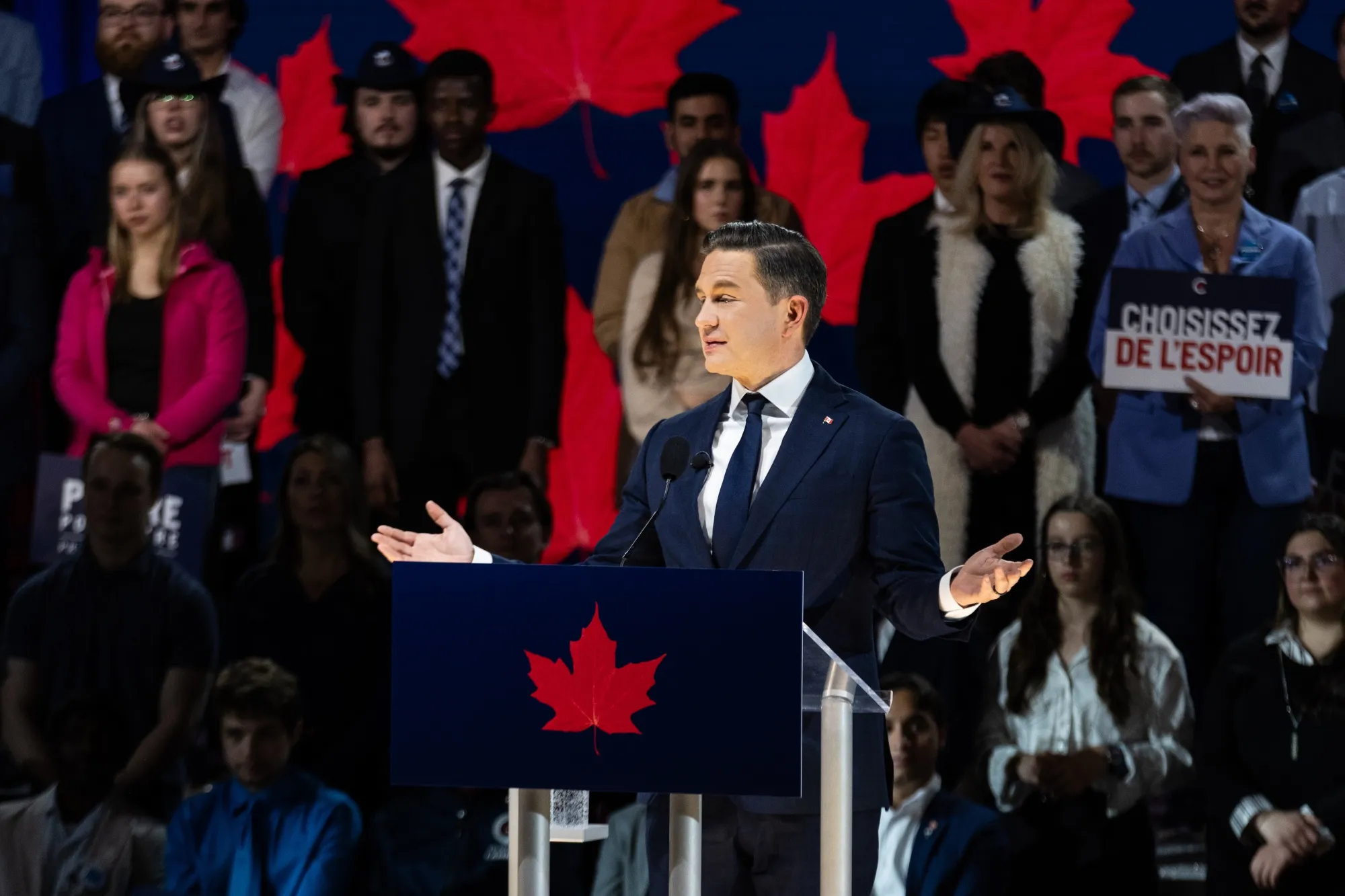
One of the interview’s most memorable lines came when he said, “You can’t hire a realtor and move your country away.” The phrase stood out because it captured his broader point in plain language. Geography, shared infrastructure, and history make complete detachment unrealistic.
That remark also served another purpose. It pushed back against any suggestion that Canada could simply turn away from the United States and build an entirely separate future overnight. Poilievre’s position was that the relationship is too important to abandon and too important to leave unrepaired.
In his telling, the solution is not distance but a better deal. Canada and the United States will continue to live beside one another, trade with one another, and depend on one another. Because of that, the smarter path is to improve the terms of cooperation.
Another notable part of the interview involved Poilievre’s explanation for not spending time in Washington during his American trip. He said, “We only have one prime minister at a time,” making clear that he did not want to complicate ongoing official negotiations through parallel political activity.
That line allowed him to strike a careful balance. On one hand, he wanted to show respect for the principle that active diplomacy belongs to the sitting government. On the other, he still wanted to argue that he was engaging internationally in a way consistent with national interest.
According to his explanation, the purpose of the trip was not to enter formal negotiations but to speak directly to Americans, lawmakers, and governors. That approach suggested he sees public persuasion and political outreach as part of shaping the climate around trade discussions.
It also revealed a broader political instinct. Poilievre appears to understand that trade debates do not unfold only at negotiating tables. They also take shape in media interviews, regional conversations, and discussions with those whose states and industries benefit from Canadian partnership.

Throughout the interview, he tried to frame Canada not as a country asking for sympathy, but as one offering serious value. That distinction matters politically. It allows him to present strength without sounding dismissive of cooperation, and it gives his message a more practical tone.
For voters, this framing may be especially important. Many Canadians want leaders who can defend national interests while keeping the economic relationship with the United States stable. Poilievre’s language suggested he wants to be seen as someone prepared to do both with sharper strategy.
His comments also fit a broader political image he has been building. He often speaks in direct, memorable phrases, but underneath them is an effort to present a larger thesis. In this case, that thesis is that Canada has underused its assets in dealing with Washington.
By highlighting energy, minerals, manufacturing inputs, and supply-chain importance, he was building a case that Canada’s influence is grounded in concrete realities. These are not abstract claims about national pride. They are arguments about what the American economy needs and where Canada fits.
The overall takeaway from the Bloomberg interview was clear. Poilievre wants Canadians to believe their country has more bargaining power than it typically claims, and he wants them to see him as a leader who would press that advantage with greater determination.
Whether voters agree with his strategy or not, the interview gave a focused view of how he thinks about cross-border trade. He is arguing that Canada’s strength comes from being indispensable in key areas, and that successful negotiation begins by acting like that is true.