Sensitive Content – For Adults Only (18+) This article examines historical punishment practices in Asia from an educational and reflective perspective. It does not glorify or promote violence, but rather seeks to understand the past in order to prevent similar injustices from recurring in the future.
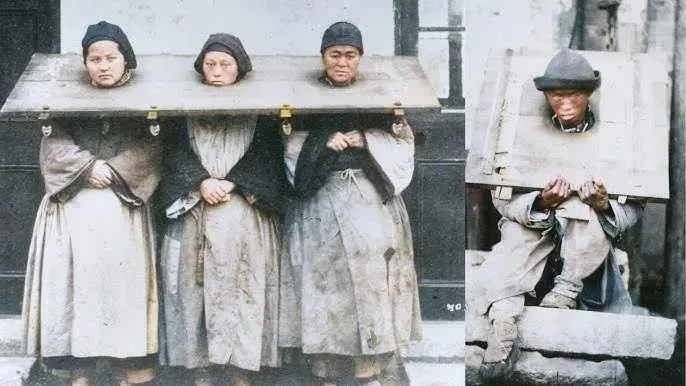
In the harshest corners of East Asian judicial history, there exists an instrument that, while not explicitly designed to kill, ended up becoming a death sentence for many.
This is the cangue, known in Chinese as “jia” or “tcha”, a public punishment device that symbolizes, like few others, the union between law, social shame and human suffering in pre-modern societies.
Used for centuries in China—and later in regions under its cultural influence such as Vietnam, Korea, and Japan—cangue was one of the most disturbing forms of punishment, not because of its immediate violence, but because of its slow cruelty , sustained by humiliation and social isolation.
What was cangue and how did it work?
The cangue consisted of a large wooden board, usually square or rectangular, with a central hole through which the condemned person’s neck was inserted. In some cases, it also included openings to immobilize the arms.
Once in place, the device closed and locked, becoming a portable prison impossible to remove without external help.

The weight varied depending on the severity of the crime. The lighter versions could weigh around 10 or 15 kilos, while the most severe reached up to 50 kilos, causing constant strain on the neck, back, and legs.
The design prevented the punished person from lying down, feeding himself, or performing basic tasks, forcing him to depend entirely on the compassion of others.
A punishment based on public shame
Unlike other methods of corporal torture, the cangue was intended for public display , not execution. The punishment began after a trial or public sentencing. The condemned person was taken to crowded places—markets, crossroads, squares—where the cangue was placed on them in front of everyone.
Inscribed on the surface of the board, in large, visible characters, were the name of the accused, the crime committed, and the length of the sentence . In this way, the punishment fell not only upon the body, but upon the very identity of the individual. The entire society became its permanent judge.
The crimes punishable by the cangue ranged from petty theft and adultery to administrative infractions and moral offenses. It wasn’t always reserved for serious crimes, which makes its prolonged use all the more disturbing.
Survival depended on the community
The cruelest aspect of the cangue lay in its absolute dependence on the social environment . The punished person could not bring food to their mouth or drink water without help. If passersby showed pity, they could survive. But if the crime provoked rejection or contempt, the consequence was total abandonment.
Numerous historical accounts describe people who, after days or weeks of exposure , succumbed to dehydration, hunger, or the harsh weather. Thus, the cangue became a form of indirect execution , where death was not ordered by law, but tolerated by collective silence.
In some cases, the condemned person was also chained to a post , further reducing their mobility and increasing physical and psychological suffering.
Psychological torment: when humiliation destroys the individual

Beyond the physical pain, the true core of cangue was the destruction of human dignity . Day after day, the punished person endured stares, insults, mockery, and rejection. Shame became a tool of social control, reinforcing hierarchies and moral norms.
This system reflected a conception of justice where punishment did not seek rehabilitation, but rather public shaming . The message was clear: whoever defied the established order would be reduced to a cautionary tale.
Regional expansion and historical decline
Under Chinese cultural influence, similar versions of cangue appeared in Vietnam, Korea, and Japan , although in some places its use was less lethal. Even so, the principle was the same: to humiliate in order to discipline .
With the arrival of Western ideas, legal reforms, and modernization movements, these practices began to be questioned. In China, cangue was officially abolished in 1905 , during the Qing dynasty’s efforts to modernize its judicial system and align it with more humane standards.
Lessons for the present
Analyzing the cangue from an objective perspective is not an exercise in morbid curiosity, but rather in historical memory . This punishment reminds us of the extent to which legal systems can dehumanize when dignity is not a core value.
The history of cangue underscores the importance of rejecting degrading practices , embracing restorative justice, and building legal systems based on human rights. Understanding these dark episodes is essential to ensuring that punishment never again becomes a spectacle of humiliation.
Final reflection
The shaming didn’t just imprison the body: it imprisoned the soul . It was a symbol of an era in which shame was considered a legitimate weapon of the state. Today, looking back, that history confronts us with an uncomfortable but necessary question: have we truly learned to punish without dehumanizing?
Remembering the cangue is, ultimately, a call to defend compassion, dignity, and human justice , so that the mistakes of the past are not repeated in new forms.